MS in Chemical Engineering
The M.S. in Chemical Engineering program includes the following focus areas: Bioengineering & Biomedical Engineering; Polymer Science & Engineering; Separations; Reaction Engineering; Sustainability; and Engineering Pedagogy.
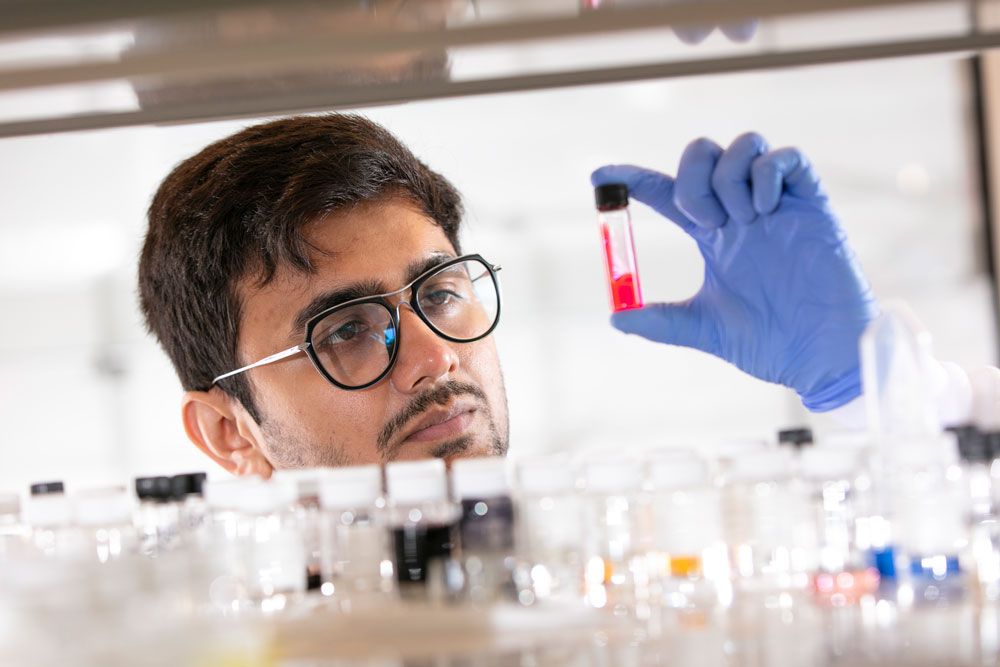
Why choose Rowan's chemical engineering program?
Our Master of Science in Chemical Engineering provides the opportunity to work on real-world projects in state-of-the-art facilities.
In our program, you participate in an applied, hands-on education and build the knowledge and training needed to effectively contribute to the field of engineering. The Chemical Engineering specialization emphasizes project management skills and industrially relevant research that prepares students for careers in high-tech fields. This program includes the following focus areas: Bioengineering & Biomedical Engineering; Polymer Science & Engineering; Separations; Reaction Engineering; Sustainability; and Engineering Pedagogy.
As a student, you can choose between a thesis track and a coursework track. You may also work on a project, which can count toward a coursework track degree. Most full-time students work on funded research projects, leading to a thesis. Most part-time students select the coursework track. In order to be eligible for a Teaching or Research Assistantship, students must select the thesis track.
- Thesis Track: The thesis option requires the completion of 30 semester hours, 6-9 of which are in thesis research/engineering project.
- Non-Thesis Track: The non-thesis option requires the completion of 30 semester hours of coursework.
Key considerations
Quick Facts
Credits
Application Deadlines
Fall Entry Term
Spring Entry Term
Summer Entry Term
Studying chemical engineering at Rowan
What You'll Learn
The Rowan University Master of Science in Engineering program requires the completion of 30 semester hours (s.h.).
The following courses make up the M.S. in Chemical Engineering program.
- 10 Courses / 30 Semester Hours
- Foundation Courses: Yes
- Graduation / Exit / Thesis Requirements: Yes
Required Courses: 9 S.H.
| Course Number | Title | S.H. (Credits) |
| MATH 01515 | Engineering Applications of Analysis | 3 |
| ----- | Engineering Application of Computers | 3 |
| ----- | Approved Business Course | 3 |
Specialization Courses: 12-15 S.H.
| Course Number | Title | S.H. (Credits) |
| CHE 06506 | Process Heat Transfer | 3 |
| CHE 06508 | Membrane Process Technology | 3 |
| CHE 06510 | Biochemical Engineering | 3 |
| CHE 06512 | Safety In The Process Industries | 3 |
| CHE 06514 | Transport Phenomena For Engineers | 3 |
| CHE 06515 | Advanced Reactor Design | 3 |
| CHE 06516 | Advanced Separation Process Technology | 3 |
| CHE 06518 | Polymer Engineering | 3 |
| CHE 06520 | Green Engineering Design In The Chemical Industry | 3 |
| CHE 06528 | Fluid Flow Applications In Processing And Manufacturing | 3 |
| CHE 06568 | Electrochemical Engineering | 3 |
| CHE 06570 | Air Pollution Control | 3 |
| CHE 06572 | Biomedical Process Engineering | 3 |
| CHE 06574 | Advances In Particle Technology | 3 |
| CHE 06576 | Bioseparation Processes | 3 |
| CHE 06577 | Advanced Engineering Process Analysis And Experiemental Design | 3 |
| CHE 06579 | Industrial Process Pathways | 3 |
| CHE 06580 | Optimization Of Engineering Projects | 3 |
| CHE 06581 | Advanced Process Analysis | 3 |
| CHE 06582 | Food Engineering Systems | 3 |
| CHE 06588 | Advanced Process Control Automation and Design | 3 |
| ENGR 01591 | Experiential Engineering Education | 3 |
Thesis / Project Courses: 6-9 S.H.
| Course Number | Title | S.H. (Credits) |
| ENGR 01599 | Masters Research | 9 |
Note: The courses listed above are not official and are subject to change. For an official list of available courses please visit the Rowan University Academic Catalog.
Admission Requirements
The following is a list of items required to begin the application process for the program. There may be additional actions or materials required for admission to the program. Upon receipt of the materials below, a representative from the Rowan Global Admissions Processing Office will contact you with confirmation or will indicate any missing items.
- Completed Application Form
- Completed foundation courses
- Note about foundation courses: The following undergraduate courses must be taken at an accredited institution: Chemistry I, Physics I, Calculus I, II, and III, Linear Algebra, and Differential Equations.
- No application fee required
- Bachelor's degree (or its equivalent) from an accredited institution of higher learning
- Official transcripts from all colleges attended (regardless of number of credits earned)
- Current professional resume
- Typewritten statement of professional objectives
- Provide reasons for pursuing the program. Describe how you might use this program to advance your career (educational goals beyond the master's level, if applicable, are also relevant).
- Two letters of recommendation
- Letters of recommendation should be from professional administrators and include information which attests to applicant's ability to pursue a graduate degree
- Minimum undergraduate cumulative GPA of 3.0 or better (on a 4.0 scale)
- If an applicant is not approved for full admission, but the Faculty Admissions Committee believes they shows promise, an offer of Probationary Admission may be extended. Probationary Admission is granted on the condition that the student meets a set number of requirements, such as minimum successful grade in a fixed number of courses, additional essay work, or other requirements as outlined by the Committee. If Probationary Admission is offered, it will be noted in the applicant's official admission decision letter from Rowan University.
- Optional Interview (If an interview is required, students will be contacted directly by the Faculty Admissions Committee regarding the interview. The interview can be in person or via telephone.)
Tuition and Aid
At Rowan University, we pride ourselves on being vigilant and frugal about tuition. We work hard to provide quality education while seeking to reduce the barrier that college costs can present students.
We know paying for tuition can be a challenge. That is why Rowan provides students with the financial resources needed to put their education first by offering grants, loans, work-study, and scholarships.
Careers and outcomes
When you complete your masters at Rowan, you are gaining hands-on experience from a nationally-recognized leader in engineering education. Our real-world applications and professional development opportunities position you at the forefront of the field, as the demand for chemical engineers is projected to grow at an average rate of 6 percent from 2018 to 2028, according to the Bureau of Labor Statistics (BLS).
Upcoming virtual information sessions and events
Become a chemical engineer